Why DAPA Violates APA

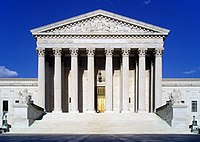
USSupremeCourtWestFacade.JPG

The Supreme Court, earlier this term extended the time that would normally have been slated for arguments on the immigration case this term, US v. Texas. This Monday, it heard those arguments.

Some background: the Obama administration has sought to implement a program it calls Deferred Action for Parents of Americans (DAPA), effectively allowing people in the US illegally to remain here, work lawfully, and receive other benefits that would otherwise be withheld from them by law.

One of the arguments against DAPA is that it violates APA. Also, that's the only argument that employs rhyming acronyms, so it is presumably the important one. APA is the Administrative Procedure Act, and it created notice and comment procedures for new administrative rules. Opponents of the Obama policy contend that DAPA is a new rule within the scope of APA, yet it was initiated without the proper notice-and-comment period, thus it is invalid.

Apparently it is the Secretary of Homeland Security who should issue the notice and receive the comments if any one should.

Legal scholars Ronald Cass and Christopher Demuth prepared a well-written amici brief making the case for a ruling against the administration on APA grounds.

The key point? DAPA goes beyond simply declining to prosecute, and changes the legal status of certain individuals, thus rendering APA applicable.


The grant of a license differs from an exercise of enforcement discretion because a license, by its
nature, changes the legal rights and obligations of the individual to whom the license is granted. When executive officials exercise discretion not to enforce the law in particular cases, the unprosecuted  remains a lawbreaker in the eyes of the law. In contrast, the grant of a license affirmatively authorizes the license holder to engage in conduct that would otherwise be unlawful. In the eyes of the law, the conduct is permitted, not just unprosecuted.

Comments

Popular posts from this blog

Searle: The Chinese Room

John Searle has become the object of accusations of improper conduct. These accusations even have some people in the world of academic philosophy saying that instructors in that world should try to avoid teaching Searle's views. That is an odd contention, and has given rise to heated exchanges in certain corners of the blogosphere.  At Leiter Reports, I encountered a comment from someone describing himself as "grad student drop out." GSDO said: " This is a side question (and not at all an attempt to answer the question BL posed): How important is John Searle's work? Are people still working on speech act theory or is that just another dead end in the history of 20th century philosophy? My impression is that his reputation is somewhat inflated from all of his speaking engagements and NYRoB reviews. The Chinese room argument is a classic, but is there much more to his work than that?" I took it upon myself to answer that on LR. But here I'll tak...

A Story About Coleridge

This is a quote from a memoir by Dorothy Wordsworth, reflecting on a trip she took with two famous poets, her brother, William Wordsworth, and their similarly gifted companion, Samuel Taylor Coleridge.   We sat upon a bench, placed for the sake of one of these views, whence we looked down upon the waterfall, and over the open country ... A lady and gentleman, more expeditious tourists than ourselves, came to the spot; they left us at the seat, and we found them again at another station above the Falls. Coleridge, who is always good-natured enough to enter into conversation with anybody whom he meets in his way, began to talk with the gentleman, who observed that it was a majestic waterfall. Coleridge was delighted with the accuracy of the epithet, particularly as he had been settling in his own mind the precise meaning of the words grand, majestic, sublime, etc., and had discussed the subject with William at some length the day before. “Yes, sir,” says Coleridge, “it is a maj...

The Growing Block Theory of Time

My own disposition, in regard to the philosophy of time, is toward the "growing block" theory. This is the view that past events remain realities, that present-moment events are also realities, but that future events are not yet real. The image is of the universe as a block with an edge on (say) the right-hand side. The block is expanding because that edge is moving ever further right, and that edge is what we call the present, or, simply, "now." Everything to the left of that edge is both static (the past is complete) and, still and forever, real. Think of the phrase "the moving finger writes." The chief alternatives to the growing-block theory are "presentism" (only the now-edge itself is real) and "eternalism" (past, present, and future are all real." I believe that time is a growing block because (1) that's what it feels like, (2) we should stick with the introspective phenomenon unless we have good reason to abandon ...